Cool Gardens: Hampton Court’s Working Wetlands Garden renamed for its permanent NE home
The gold-medal-winning Working Wetlands Garden at last year’s RHS Hampton Court Palace Flower Show has been renamed Washington Water Lab. The name change is in honour of its new home at Washington Wetland Centre in Tyne and Wear.
It’s an inspiring outdoor classroom, themed around the water cycle, part of Wildfowl and Wetlands Trust’s (WWT) aim to provide innovative learning experiences for children.
The exciting and practical space means children can discover the vital role wetlands play in our lives, with the help of beautiful images, water features, and plants that come alive in the rain.
Funding comes from the HSBC Water Programme and its support for the Inspiring Generations programme, which has enabled more than 69,000 school children from deprived areas to experience free learning sessions since 2012. Read more about rain gardening to stop flooding here.


Washington Water Lab – a magnet for wildlife and pollinators
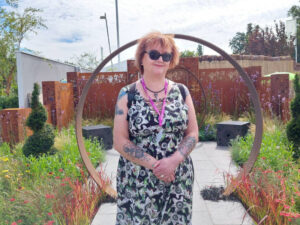
Designer Jeni Cairns, who created the original garden, was there to see the unveiling. The original Working Wetlands Garden was designed as a haven for wildlife and people. It demonstrated a solution to flash flooding caused by urban run-off, made worse by car parks, roads and roofs speeding up the rate water flows into drains.
Water from the roof collects into a mini wetland. As water passes through the cascading water feature, soil and plants filter and clean it.
The purified rainwater fills a pond bursting with wildlife. After very heavy rain, the pond overflows into a series of low wetlands and ‘swales’, which store the water, releasing it slowly.


First incarnation – at RHS Hampton Court Palace Flower Show 2016
In the process, this wetland garden creates an excellent habitat for nature and a beautiful place for people. It also works hard to prevent flash floods downstream.
The garden uses 85 plant species, mostly British natives. Summer flowering plants include loosestrife, flowering rush, and greater spearwort – providing a predominant purple mixed with cream and yellow. There are plenty of varieties to please pollinators and wildlife, such as cornflowers, teasels, scabious and foxgloves.
Several features of the garden are recycled. The pagoda roof is the inverted roof of a grain silo; bench supports are made from the silo’s girders; the cascade was a warehouse air duct; the chain cascade is made from an old harrow; upcycled sheets of metal have been used to make relief water scenes of dragonflies and kingfishers.
Washington Water Lab – Getting there
WWT Washington Wetland Centre is at Pattinson, Washington, Tyne and Wear NE38 8LE, tel (0191) 416 5454. It sits on the north bank of the River Wear, overlooked by Penshaw Monument.
The centre lies east of Washington town centre in Pattinson (formerly District 15), four miles from the A1(M), one mile from the A19, signposted off the A195, A19, A182, and A1231 Washington Highway.
For more information, visit www.wwt.org.uk/wetland-centres/washington.
Washington Water Lab at WWT Wetland Centre updated August 2022